Showing posts with label cameras. Show all posts

Friday, December 26, 2008

1980 Rare FED-5B "Moscow Olympics" Com­mem­o­ra­tive Edition vintage camera

I'm starting to enjoy collecting vintage cameras from the former Soviet Union. My newest rare find was a special version of the FED-5B rangefinder camera produced in limited quantities to commemorate the 1980 Olympic Summer Games in Moscow.

Back in 1980, the 22nd Mod­ern Olympic Summer Games were held in Moscow during the height of the Cold War. To pro­mote the glorious event, all cam­era man­u­fac­tur­ers is­sued one or more com­mem­o­ra­tive mod­els of their 1979 or 1980 cam­eras. This "com­pli­an­cy" was so uni­formed and planned at that time, it seemed to in­di­cate that they were com­mis­sioned by the Soviet gov­ernment.

Affectionately nicknamed the "Moscow '80 vari­ants" by camera enthusiasts, they're worth more than the stan­dard model and valued sub­stan­tial­ly higher in terms of its "So­vi­et mem­o­ra­bil­ianess".


Interestingly enough, The 1980 Moscow Olympics was perhaps most famous for the US-led boycott that saw only 80 out of 147 nations compete, the lowest number since the 1956 Melbourne Games. The boycott was made in protest of the Soviet invasion of Afghanistan the year before, one of the many conflicts that took place during the Cold War years. US allies such as Britain and France also condemned the invasion but allowed their athletes to compete nonetheless.


Here's a bit of info about the maker: the FED was generally a rangefinder camera, mass produced from 1934 until around 1990, and also the name of the factory that made it. Named after Felix Edmundovich Dzerzhinsky, founder of the Cheka (Predecessor to the KGB). It was his name that was given to the labour commune at Kharkiv (Ukraine) whose manager, Anton Makarenko, encouraged a workshop education for indigent children and who decided to copy the Leica in 1932.


Large-scale production began in 1934, and in the same year the factory was put under NKVD (Secret Police of the Soviet Union) control and Makarenko was fired. Production continued until 1941, when German forces destroyed the factory during WW2, and resumed again in 1946.

From 1955 onwards, the factory made a huge volume of cameras that resemble the Leica rather closely (and are often altered, given "Leica" markings, and sometimes even sold as Leicas). However, the design was much cruder.


FED innovated the cameras further, combining the rangefinder with the viewfinder in the FED-2 and all its successors. The FED-3 added slow shutter speeds and on the later version FED-3 (b) the film advance was changed from a thumb wheel to a lever. The FED-4 (1964–77) added a non-coupled selenium exposure meter. The FED-5 marked the end of the FED rangefinder family, and was meant as an improved replacement for both the FED-3 and FED-4 that were in production at the time of its introduction.

There were three versions of the FED-5: the original FED-5 had an exposure meter, the FED-5B was a version without meter, and the later FED-5C had reflected framelines showing field of view of 50mm lens and an exposure meter.


All FED-5 cameras were delivered with an Industar I-61L/D lens. This lens replaced its predecessor Industar-26m. The optical design was improved, and a new, Lanthanum glass was used. It is sharp and contrasty, with smooth focusing action and the aperture click-stops.

Sadly, the production of FED rangefinder cameras ended in the mid 1990s. In terms of looks, this camera definitely stands apart from the throng of other Russian deadstock. And with it's Moscow 80's logo, it's definitely a gold medal winner in my book.

SPECIFICATIONS:

Film Type: all standard 35mm
Lens: Industrar 61 1:2.8 f=55mm
Focal Range: .75mm to ∞
Shutter Speeds: B, 1, 1/2, 1/4, 1/8, 1/15, 1/30, 1/60, 1/125, 1/250, 1/500
Aperture Settings: f/2.8, f/4, f/5.6, f/8, f/11, f/16
Flash Connection: standard hot-shoe, sync at 1/30


[see lo-fi pics taken by FED-5B]


Offer Price: B$225

Saturday, October 25, 2008

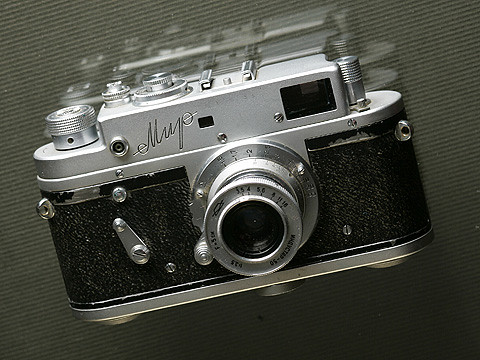
Zorki 4 'Mir' | Russian Leica Clone


Zorki (meaning sharp-sighted) is a series of 35mm rangefinder cameras manufactured in the name of a series of manufactured in the Soviet Union, by the KMZ (Krasnogorskiy Mekhanicheskiy Zavod) factory near Moscow between 1948 and 1978. The first Zorki cameras were largely based on the Leica II, a trend which was discontinued later when the factory began producing Zorki cameras which were original to a great degree.

In 1956, KMZ started selling the Zorki 4 and it spawned two variants, the improved lever advance equipped Zorki 4K and the low-cost watered Zorki Mir. Zorki 4 is widely regarded as one of the finest Russian cameras and over two million of theses sold.

Perhaps one of the more notable feature of the Zorki cameras was their shutter speed, which could only be set after the shutter has been cocked, and if the shutter speed was set before the shutter is cocked there were chances that the camera might be permanently damaged.

As the Mir was a simplified version of the Zorki 4, they were manufactured for sale internal to the Soviet union at a lower price than the Zorki 4 and are scarce and are very rare in excellent condition. Interestingly, 'Mir' means peace in Russian and were manufactured from 1959 to 1961.


When they say "simplified" what do they mean? As far as I can tell the only difference between the Zorki 4 and the Mir is that the Mir does not have the 4's slow shutter speeds (between 1/30th and B). As the Zorki 4's slow shutter speeds have something of a reputation for failing this doesn't seem to be much of a sacrifice and when was the last time you set your camera's shutter to 1 second anyway?

The only other thing I found that is stripped down about the Mir is the lens that came as standard; instead of the typical, beautiful Jupiter 8 that comes with most Zorki 4s, my Mir sports a Indistrar so instead of a nice fast f2 you're armed with an OK f3.5.

The Zorki 4 was loosely based on the Leica II/III. Leicas, to recap, are legendary for their build quality, reliability, fantastic glass and astronomical price tags.The Russian Leicas are not legendary for any of those things. Make no mistake, when you pick up a Russian Leica clone you won't be fooled into thinking that you're holding the genuine article even if, like me, you've never held a real Leica.


Like other Russian cameras, the Mir is rough around the edges, solid metal without the reassurance of quality materials or engineering beneath its skin but its price point makes the comparison with a real Leica a little unfair. With its modest sticker price the Zorki 4 was competing more with the Argus C3 than with Leica's products. When viewed in that light the Mir is a nice camera, certainly more refined and advanced in its own way

Sample pics taken by the Mir:


SPECIFICATIONS:

Film Size: 35mm
Image Size: 24X36mm
Dimensions:
height: 6.7cm
width: 13.3cm
depth: 6.6cm
weight: 519gm
Normal lens: Industar-22/Jupiter-8
Lens Mount: m39 LTM
Typical serial no: 6070196

Offer Price: B$225 ***SOLD*** Thanks to the buyer!

Wednesday, October 15, 2008

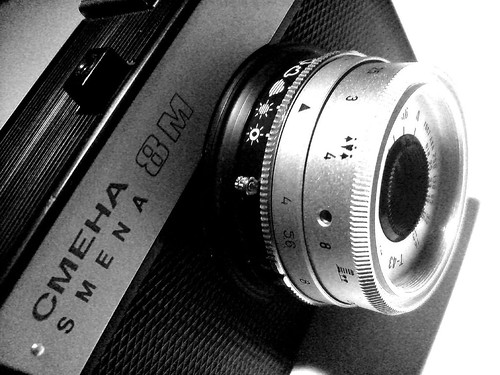
Lomo Smena 8M | Soviet 35mm Camera


In the early 70's, at a time when Western countries filled their cameras with decadent electronic gizmos, the glorious Soviet Union decided to offer its heroic workers a tool to put their natural creativity at the service of the Party and to take pictures of their holidays at Novosibirsk. The Lomo Smena 8M was born.

Produced as a cheap camera by the legendary LOMO production house of St. Petersburg, the Smena 8M looks like a box with a lens stuck on it, but is in fact so much more. With fully manual shutter speeds, aperture and range finder focusing the Smena 8M is the obvious step up from a more simple toy camera (such as the Holga 135BC in my case) to a more sophisticated camera with greater control over your photographs, whilst keeping the charm of a toy camera and not breaking the bank.

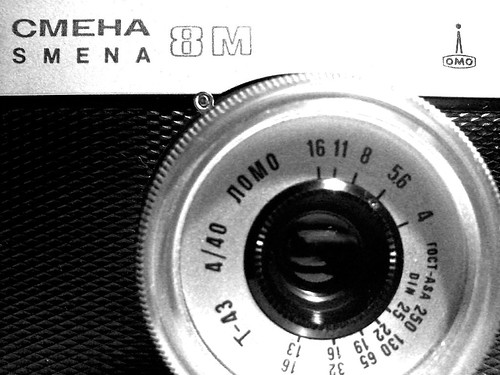
Made of plastic except for the aluminum lens and shutter assembly, the Smena 8M is very light and is surprisingly capable of producing sharp pictures. While the viewfinder is rather useless – it’s just a lens-less, clear frame that’s pretty inaccurate – it has a coated 40 mm f/4 T-43 triplet lens that delivers nice saturation and contrast. The fully manual controls (aperture, shutter speeds from 1/15 s to 1/250 s, and focal distance) allow you to create your images as you please. It’s even equipped with a leaf shutter and PC flash sync – enabling flash syncing at various shutter speeds.


This may sound unnerving, but the 8M is quite easy to use with a little practice. The shutter-speed ring has a small icon for each setting, ranging from a sun to a dark cloud. The idea being, that the aperture should be set to the film speed (f/16 for ISO400, f/8 for ISO200, etc), then the shutter-speed should be set using the icon for the current lighting situation. The focus can be set by selecting the distance of the subject, then all that remains is to cock and shoot.

The word "Smena" (Cmeha) is roughly translated into "Young Generation" in English. True to its name, the Smena line of cameras were designed to provide inexpensive, accessible, and excellent photography tools to the hard-working young Soviets of the time. The first Smena model rolled out of assembly in 1952. The popularity of this line was so enduring, that Smenas continued to be produced until the late 1980's.

Personally I’ve found the Smena 8M to be a b-e-a-utiful piece of Russian deadstock. With a contrasty and saturated lens, simple manual controls, and a look that says, “I AM RUSSIAN, I AM AWESOME” – and with a fleeting glance at the bottom of the lens barrel – “I WAS MADE IN THE USSR!”, this cold-war babe is a hot one,

[see lo-fi pics taken by Smena 8M]

SPECIFICATIONS:

- Lens: Triplet 43, 40 mm, f/4, 3 elements
- Focal range: 1 m to infinity, scale-focus
- Shutter speeds : B, 1/15, 1/30, 1/60, 1/125, 1/250
- Shutter type: 3 blades diaphragm shutter
- Apertures: f/4, f/5.6, f/8, f/11, f/16
- Film type: 35 mm film
- Size: 70 x 100 x 60 mm
- Weight: 289g

Offer Price: B$155 *** SOLD *** Thanks to the buyer!

 
© 2008-2009 Master Vintage | all rights reserved | e-mail: mastervintage@gmail.com | template by suckmylolly.com