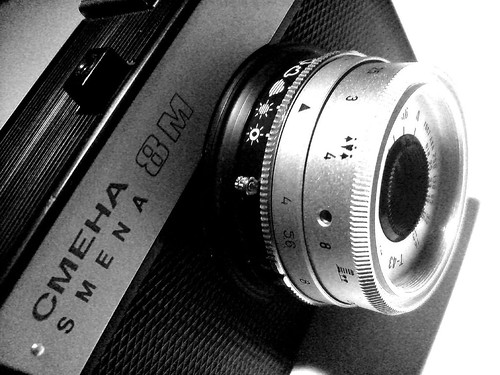
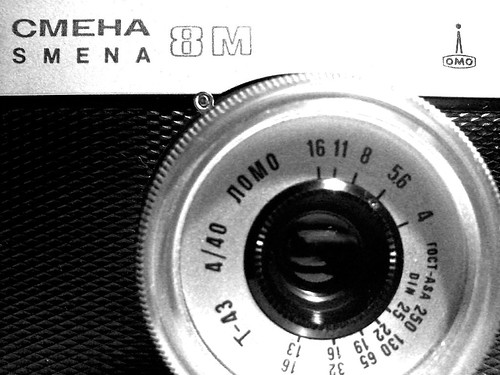
I'm starting to enjoy collecting vintage cameras from the former Soviet Union. My newest rare find was a special version of the FED-5B rangefinder camera produced in limited quantities to commemorate the 1980 Olympic Summer Games in Moscow.
Back in 1980, the 22nd Modern Olympic Summer Games were held in Moscow during the height of the Cold War. To promote the glorious event, all camera manufacturers issued one or more commemorative models of their 1979 or 1980 cameras. This "compliancy" was so uniformed and planned at that time, it seemed to indicate that they were commissioned by the Soviet government.
Affectionately nicknamed the "Moscow '80 variants" by camera enthusiasts, they're worth more than the standard model and valued substantially higher in terms of its "Soviet memorabilianess".

Interestingly enough, The 1980 Moscow Olympics was perhaps most famous for the US-led boycott that saw only 80 out of 147 nations compete, the lowest number since the 1956 Melbourne Games. The boycott was made in protest of the Soviet invasion of Afghanistan the year before, one of the many conflicts that took place during the Cold War years. US allies such as Britain and France also condemned the invasion but allowed their athletes to compete nonetheless.

Here's a bit of info about the maker: the FED was generally a rangefinder camera, mass produced from 1934 until around 1990, and also the name of the factory that made it. Named after Felix Edmundovich Dzerzhinsky, founder of the Cheka (Predecessor to the KGB). It was his name that was given to the labour commune at Kharkiv (Ukraine) whose manager, Anton Makarenko, encouraged a workshop education for indigent children and who decided to copy the Leica in 1932.

Large-scale production began in 1934, and in the same year the factory was put under NKVD (Secret Police of the Soviet Union) control and Makarenko was fired. Production continued until 1941, when German forces destroyed the factory during WW2, and resumed again in 1946.
From 1955 onwards, the factory made a huge volume of cameras that resemble the Leica rather closely (and are often altered, given "Leica" markings, and sometimes even sold as Leicas). However, the design was much cruder.
From 1955 onwards, the factory made a huge volume of cameras that resemble the Leica rather closely (and are often altered, given "Leica" markings, and sometimes even sold as Leicas). However, the design was much cruder.

FED innovated the cameras further, combining the rangefinder with the viewfinder in the FED-2 and all its successors. The FED-3 added slow shutter speeds and on the later version FED-3 (b) the film advance was changed from a thumb wheel to a lever. The FED-4 (1964–77) added a non-coupled selenium exposure meter. The FED-5 marked the end of the FED rangefinder family, and was meant as an improved replacement for both the FED-3 and FED-4 that were in production at the time of its introduction.
There were three versions of the FED-5: the original FED-5 had an exposure meter, the FED-5B was a version without meter, and the later FED-5C had reflected framelines showing field of view of 50mm lens and an exposure meter.
There were three versions of the FED-5: the original FED-5 had an exposure meter, the FED-5B was a version without meter, and the later FED-5C had reflected framelines showing field of view of 50mm lens and an exposure meter.

All FED-5 cameras were delivered with an Industar I-61L/D lens. This lens replaced its predecessor Industar-26m. The optical design was improved, and a new, Lanthanum glass was used. It is sharp and contrasty, with smooth focusing action and the aperture click-stops.
 Sadly, the production of FED rangefinder cameras ended in the mid 1990s. In terms of looks, this camera definitely stands apart from the throng of other Russian deadstock. And with it's Moscow 80's logo, it's definitely a gold medal winner in my book.
SPECIFICATIONS:
Film Type: all standard 35mm
Lens: Industrar 61 1:2.8 f=55mm
Focal Range: .75mm to ∞
Shutter Speeds: B, 1, 1/2, 1/4, 1/8, 1/15, 1/30, 1/60, 1/125, 1/250, 1/500
Aperture Settings: f/2.8, f/4, f/5.6, f/8, f/11, f/16
Flash Connection: standard hot-shoe, sync at 1/30
[see lo-fi pics taken by FED-5B]
Offer Price: B$225